
Fees & Pricing
How to read your credit card processing statement, line by line
10 min read
Quick answer
A merchant statement lists your monthly card sales, then breaks the cost into interchange (paid to the card-issuing bank), assessments (paid to Visa/Mastercard), and your processor's markup. To read it, find your total volume, add up all fee lines, and divide by volume to get your effective rate, then compare that to what you were quoted.
Key takeaways
- Your statement's most useful number is your effective rate: total fees divided by total processed volume.
- Interchange and assessments are set by the card networks and banks, your processor can't change them.
- Markup, batch fees, PCI fees, and monthly minimums are the lines your processor actually controls and where negotiation happens.
- Vague line items like 'miscellaneous' or 'regulatory fee' deserve a direct question to your provider.
- Comparing statements month to month catches creeping fees before they add up to real money.
Why most merchants never read their own statement
Merchant statements are designed by people who deal with them every day, not by people trying to run a shop or a restaurant. The layout is dense, the terminology is unfamiliar, and most business owners glance at the total, confirm it roughly matches what landed in the bank, and move on. That's exactly how creeping fees go unnoticed for years. Once you know what each section means, reading your statement takes about ten minutes a month and it's one of the most reliable ways to catch overcharges, see our related guide on hidden credit card processing fees for the patterns to watch for.
The three layers of every card transaction
Nearly every dollar in fees on your statement falls into one of three buckets. Understanding this structure is the fastest way to make sense of an otherwise confusing document, and it's the same structure we cover in more depth in credit card processing fees explained.
| Layer | Who receives it | Can your processor negotiate it? |
|---|---|---|
| Interchange | The customer's card-issuing bank | No, set by Visa, Mastercard, Discover, Amex |
| Assessments | The card network itself | No, set by the network, a small fixed percentage |
| Markup | Your processor | Yes, this is the part that's actually negotiable |
Section by section: what you'll actually see
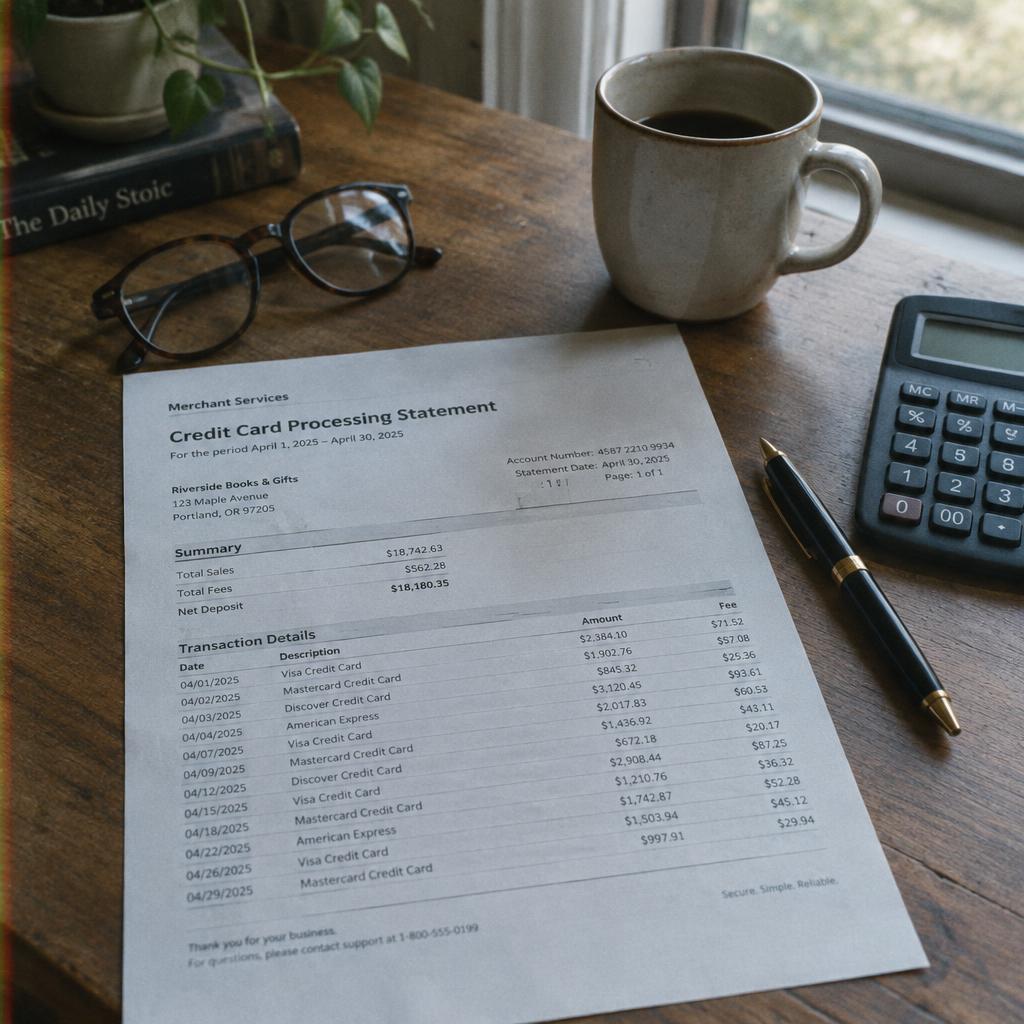
1. Summary or batch totals
Usually at the top: your total sales volume, number of transactions, and total fees for the period. This is the section most owners glance at, but it's only useful once you know how to compare it against the detail below.
2. Interchange detail
A list of interchange categories your transactions fell into, each with its own rate. Debit cards, rewards cards, corporate cards and basic consumer cards all have different interchange rates, which is why two businesses with identical sales totals can have very different fee totals depending on what kinds of cards their customers use.
3. Assessments
A small percentage (often under 0.15%) paid directly to the card network. This line is nearly identical across processors because no processor controls it, if a provider claims they can waive it, that's worth a follow-up question.
4. Processor markup
This is your processor's actual profit on your account, shown either as a percentage add-on (interchange-plus pricing) or folded into a single flat rate. This is the one section where your negotiating leverage actually matters, see interchange-plus vs. flat-rate pricing for how the two models present this differently on paper.
5. Fixed and recurring fees
Monthly statement fees, PCI compliance fees, batch fees, gateway fees, and sometimes a monthly minimum. Individually small, these add up, especially for a lower-volume business where a $10 monthly fee eats into margin more than it would for a high-volume shop.
6. Chargebacks and adjustments
Any disputes, retrieval requests or reversed transactions show up here, often with their own fee per incident regardless of outcome. A rising count here is worth investigating, our guide to preventing chargebacks covers the most common causes.
Calculating your effective rate
This is the single most useful number on the whole statement, and it's simple to calculate: add every fee line for the month, divide by your total processed volume for the month, and multiply by 100. That percentage is what you're actually paying, all-in, regardless of how the pricing was marketed to you.
- 1Find your total monthly card volume, usually near the top of the statement.
- 2Add every fee line: interchange, assessments, markup, and all fixed fees.
- 3Divide total fees by total volume.
- 4Multiply by 100 to get your effective rate as a percentage.
- 5Compare that number month to month, and against quotes from other providers.
Red flags worth a phone call
- A vague line labeled 'miscellaneous fee,' 'regulatory fee,' or 'PCI non-compliance fee' with no explanation attached.
- A monthly minimum fee that's higher than what you'd actually pay based on volume.
- An effective rate that's crept upward over several months with no change in your card mix.
- Fees that don't match what was verbally quoted when you signed up, ask for the written schedule.
- Any fee you don't understand, a legitimate processor will explain every line without hesitation.
If your statement raises more questions than it answers, or you suspect you're paying more than you should, our guide on how to lower credit card processing fees walks through what to ask for, and how to switch payment processors covers what's involved if a change makes sense.
Minnesota businesses: get a second set of eyes
We review merchant statements at no cost for shops, restaurants and service businesses across Minneapolis, St. Paul and greater Minnesota, most reviews take about fifteen minutes and tell you plainly whether you're paying a fair rate. We also help newer businesses get set up correctly from the start; see credit card processing for new businesses if you're just getting going.
Want a second opinion on your current statement? Book a free statement review or call 763-280-3155, bring your last statement and we'll go through it together.
Frequently asked questions
Sources and references
Want this checked against your own statement?
Send us a recent processing statement and we'll mark it up line by line, what you're paying now, and what you'd pay with us. No pressure.