
Industries
Payment processing for nonprofits and churches: donations, tithing and events
8 min read
Quick answer
Nonprofits and churches can accept card and ACH donations through a donation page, a giving kiosk, or a mobile reader passed during a service or event. Many processors offer discounted nonprofit rates, and ACH is usually cheaper than cards for recurring tithing since it skips card network fees entirely.
Key takeaways
- ACH bank transfers are typically the cheapest way to process recurring tithing and monthly giving.
- Ask any provider directly for nonprofit or 501(c)(3) pricing, many offer a discount off standard rates.
- Recurring giving needs a system that automatically updates expired cards so donations don't quietly lapse.
- Giving kiosks and QR codes at the back of a sanctuary or event table capture donations that would otherwise be missed.
- Year-end giving statements and instant receipts matter for tax purposes, confirm your provider generates them.
Cash offerings have been declining for years, and most congregations and nonprofits now see the majority of giving happen electronically, recurring tithing pulled monthly, a one-time gift after a sermon or gala, or a card tapped at a fundraiser table. Setting this up well means more consistent giving, better records for your treasurer, and fewer donors who mean to give but forget because there was no easy way to do it on the spot. This guide covers the pieces specific to nonprofits and churches: giving pages, kiosks, ACH for recurring gifts, and the pricing you should actually be paying.
If your organization is setting up payments for the first time, our general guide on how to accept credit card payments covers the basics of getting a merchant account; this guide layers on what's specific to donations and giving.
What's the best way to accept donations online?
A dedicated giving page, either a standalone page on your website or a hosted donation form from your processor, is the most flexible option. It should let a donor choose a one-time or recurring gift, pick a fund or campaign if you run more than one, and receive an instant email receipt. A simple payment link works too for a quick fundraiser or specific appeal, since you can text or email it directly without building a full page.
- Embed the giving form directly on your site rather than sending donors to a generic third-party page, it builds trust and keeps your branding consistent.
- Offer both card and ACH bank transfer as options; some donors specifically prefer ACH to avoid card fees eating into their gift.
- Let donors choose to cover the processing fee themselves, many will, and it's a simple checkbox on most giving platforms.
- Make sure the confirmation email doubles as a donation receipt with your organization's tax ID.
How does recurring tithing and monthly giving work?
Recurring giving is set up much like any subscription: a donor's card or bank account is charged automatically on a set schedule, typically monthly, until they change or cancel it. This is worth actively encouraging, since recurring donors give more over time and are less likely to lapse than one-time givers. Set it up correctly and it runs quietly in the background without staff having to chase anyone down.
The one thing to check with any provider: does it automatically update expired or reissued cards? Card numbers change more often than people expect, a bank reissues a card after a data breach, or it simply expires, and without automatic updating, recurring donations quietly stop and nobody notices until the treasurer runs year-end numbers. Ask this question directly before signing up. See our full walkthrough in how to accept recurring payments for what to look for in a subscription-billing setup.
| Method | Typical cost to the organization | Best for |
|---|---|---|
| Credit or debit card | Roughly 2.2%–3.5% per transaction | One-time gifts, event donations, donors who prefer cards |
| ACH bank transfer | Often a flat, low fee or under 1% | Recurring monthly tithing and larger gifts |
What is nonprofit processing pricing and how do you get it?
Many processors, including major card networks' own nonprofit programs, offer reduced rates for registered 501(c)(3) organizations and houses of worship. This isn't automatic, you typically need to apply with your tax-exempt determination letter and mention it specifically when setting up your account. It's a straightforward conversation, but only if you ask; providers rarely volunteer the discount up front. Our guide to credit card processing fees explained covers how the underlying rate is built, which is useful context even with a nonprofit discount applied.
How should a church handle giving during a service?
A physical offering plate still matters to many congregations, but pairing it with a simple giving option removes the awkwardness for people who genuinely don't carry cash anymore. Common approaches include a giving kiosk near the entrance, a QR code printed in the bulletin that opens a mobile giving page, or a staff or volunteer member passing a mobile card reader during announcements. Any of these works, the point is removing friction for someone who wants to give but has nothing in their wallet.
- Giving kiosk: a small tablet stand near the entrance or welcome table, always available before and after service.
- QR code in the bulletin or on a screen: opens directly to your giving page, no app download needed.
- Text-to-give: donors text a keyword and amount to a number, common for churches with an older tech-averse segment plus younger members who prefer texting.
- Mobile card reader passed during the service: works well for special collections and one-time appeals.
Events, galas, and fundraisers
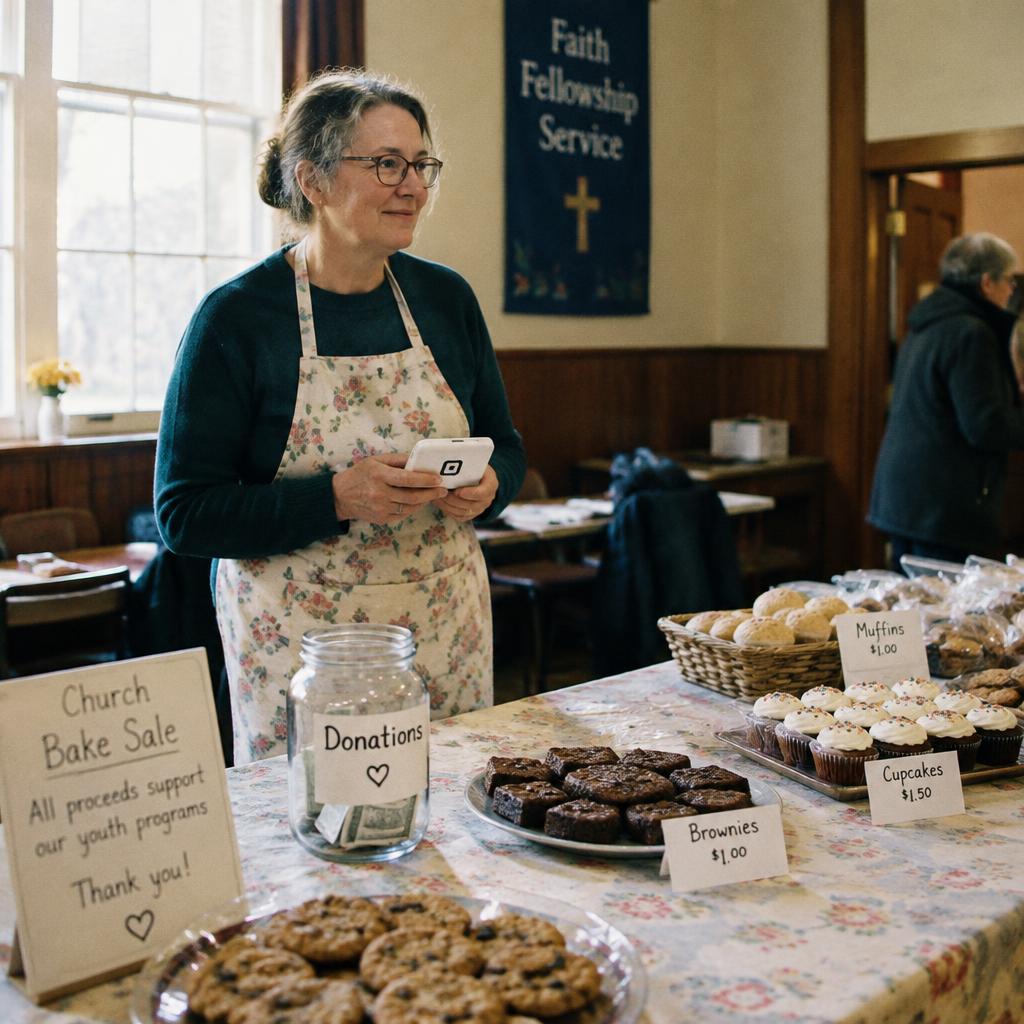
A one-night fundraiser or gala has different needs than everyday giving: you need to process a burst of card-present donations and auction payments quickly, often with volunteers running the equipment rather than trained staff. A handful of simple mobile readers linked to the same account, plus a staff member ready to walk volunteers through the tap-to-pay flow, usually covers it. Our tap to pay mobile card reader guide covers the hardware options that work well for occasional, high-volume events like this.
For silent auctions and ticketed events, a payment gateway or virtual terminal can let you key in card details from a paper bid sheet after the event, or process a preorder ticket sale on your website ahead of time.
Chargebacks and receipts for donations
Chargebacks on donations are rare but do happen, often from a donor who forgot they gave, a family member disputing a deceased relative's recurring gift, or genuine fraud on a stolen card. Keep clear records: the donor's name, date, amount, and a copy of the confirmation email. Instant, itemized receipts also matter for tax purposes, donors need documentation for gifts over $250 to claim a deduction, so confirm your platform generates that automatically rather than leaving it to your office staff to produce by hand.
What does this look like for Minnesota nonprofits and churches?
The Twin Cities has one of the country's most active nonprofit and giving communities, and Minnesota's own Give to the Max Day each November is one of the largest single-day giving events in the country, a good stress test for whether your donation page and processor can handle a spike in traffic. We work with churches and nonprofits across Minneapolis, St. Paul, and organizations throughout Minnesota to set up giving pages, kiosks, and recurring tithing systems ahead of big giving days rather than scrambling the week of.
If your congregation or nonprofit is reviewing its giving setup, book a free consultation or call 763-280-3155 and we'll walk through nonprofit pricing, recurring giving, and event-day equipment together.
Common mistakes nonprofits and churches make
- Never asking for nonprofit-specific pricing and paying standard retail rates.
- Relying only on cash or checks and losing younger, cashless donors entirely.
- Not automatically updating expired cards on recurring gifts, causing giving to quietly lapse.
- Skipping instant receipts, which creates extra year-end work for the office and donors alike.
- Using personal Venmo or Cash App accounts for organizational giving instead of a proper merchant account, this creates real accounting and liability problems.
Frequently asked questions
Sources and references
Want this checked against your own statement?
Send us a recent processing statement and we'll mark it up line by line, what you're paying now, and what you'd pay with us. No pressure.