
Fees & Pricing
Cash discount vs. surcharging: what's the difference?
9 min read
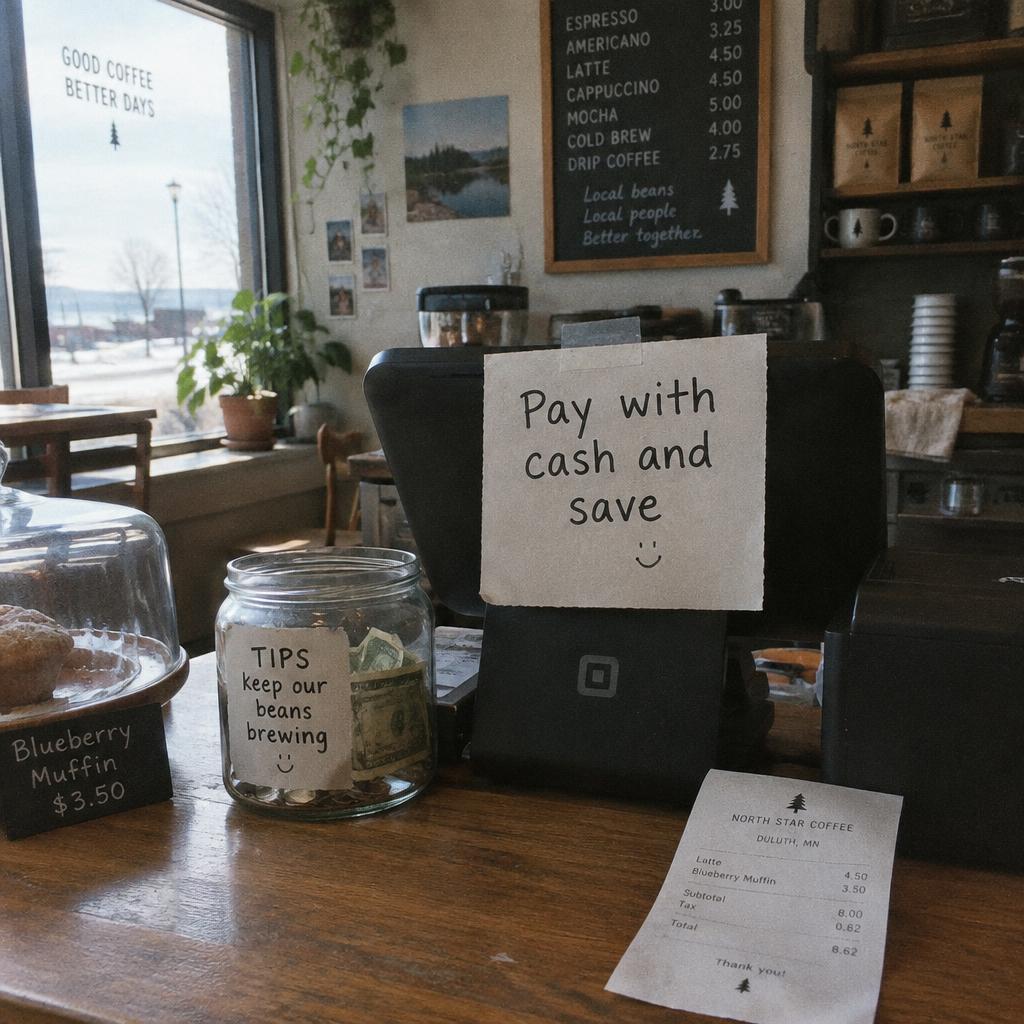
Quick answer
Cash discounting posts one price and gives customers a discount for paying cash, while surcharging posts the cash price and adds a fee (capped around 3–4%) when a customer pays by credit card. Both let a business offset processing costs, but they use different math, different signage rules, and different card network requirements.
Key takeaways
- Cash discounting shows a higher 'menu' price with a discount for cash; surcharging shows the cash price and adds a fee for credit cards.
- Surcharges are capped (commonly around 3–4%) and cannot be applied to debit cards or in states that restrict them.
- Cash discount programs must be offered to every customer, not selectively, to satisfy Visa and Mastercard rules.
- Signage and receipt disclosure are required for both models, skipping them is the most common compliance mistake.
- The right choice depends on your average ticket, your customer mix, and how comfortable your business is talking about the fee at checkout.
Two ways to offset the same cost
Every card swipe costs a business money, a mix of interchange, network fees and your processor's markup, which we break down in credit card processing fees explained. Cash discounting and surcharging are the two legal ways to shift some of that cost back onto the customer who's using the card, instead of building it into everyone's price. They sound similar, get confused constantly, and are regulated differently, so it's worth understanding both before you pick one for your shop.
How cash discounting works
In a cash discount program, the price you display already includes the cost of accepting cards. A customer who pays cash, check or debit gets a discount, often 3–4% off, taken right at the register or built into a dual price on the receipt. Because the 'sticker price' already reflects the card cost, this isn't legally a surcharge, and it sidesteps some of the state-by-state surcharging restrictions.
- Menu boards, price tags and invoices typically show two prices side by side, or one price plus a clearly stated cash discount percentage.
- The discount must be offered to every paying customer, you can't discount at the counter only for regulars.
- Card networks require signage at the entrance and again at the point of sale disclosing the program.
- This model is common in restaurants, auto shops, and contractor businesses where invoices are already itemized.
How surcharging works
Surcharging keeps your normal price as the real price. If a customer pays with a credit card, a fee, capped by the card networks, generally around 3% to 4% depending on the brand, gets added at checkout. Pay cash, debit, or check, and there's no extra charge. This is the more literal 'we're passing along the card fee' approach, and it's the one shoppers usually notice on their receipt line item.
- Surcharges can only be applied to credit cards, never debit cards, by both Visa and Mastercard rules.
- The surcharge cannot exceed your actual cost of acceptance or the network's published cap, whichever is lower.
- You must notify your card processor and, in many cases, the card networks in advance of surcharging.
- Some states restrict or ban surcharging outright, so check current state law before turning it on.
Side-by-side comparison
| Cash Discount | Surcharge | |
|---|---|---|
| Posted price | Includes card cost; cash gets a discount | Cash price; card adds a fee |
| Applies to | All non-cash payments, per program design | Credit cards only, never debit |
| Typical amount | ~3–4% discount for cash | ~3–4% fee capped by network rules, or your true cost |
| Notice required | Signage at door and register | Signage plus advance notice to processor/networks |
| State restrictions | Fewer restrictions; treated as a discount | Banned or capped in some states, check local law |
| Best fit | Restaurants, retail, service businesses with posted menus | Invoice-heavy or B2B businesses with clear line items |
Which one fits your business?
There's no universally 'better' option, it depends on how your customers pay and how your pricing is displayed today. A coffee shop with a printed menu board often finds cash discounting easier to run, since the discount is baked into signage customers already read. A contractor sending itemized invoices, on the other hand, may prefer surcharging because it's simpler to show as one added line on a bill a customer already expects to review.
- 1Look at your card mix: if most customers already pay with debit or cash, a cash discount changes little for most transactions.
- 2Check your state's rules on surcharging before committing, some states restrict it outright.
- 3Consider your customer relationships: recurring B2B clients often accept a stated surcharge more easily than retail walk-ins.
- 4Talk to your processor about which model their equipment and software supports out of the box, not all point-of-sale systems handle both equally well, a factor we cover in choosing a POS system.
- 5Ask what happens with refunds and partial payments under each model, since that trips up more merchants than the math itself.
Common mistakes that create chargebacks and complaints
The biggest risk with either program isn't the math, it's disclosure. Customers who feel surprised by a fee are far more likely to dispute the charge, and disputes hurt your standing with your processor, see our guide on preventing chargebacks. Post signage before you start, train staff to explain the program in one sentence, and make sure your receipts spell out exactly what was charged and why.
- Not posting required signage at the entrance and register.
- Applying a surcharge to a debit card by mistake, this is a compliance violation, not a technicality.
- Charging a surcharge higher than your processor's stated cap.
- Failing to tell your processor before turning surcharging on, which can trigger a review or even account issues.
- Being inconsistent, discounting some customers and not others under a cash discount program.
Minnesota businesses: what to check locally
Minnesota law affects how you can structure a surcharge, so it's worth confirming current state rules before flipping the switch, don't rely on what a neighboring state allows. We work with shops and restaurants across Minneapolis, St. Paul, and greater Minnesota to set up whichever model fits, get signage right, and configure the point-of-sale so the math is automatic instead of a manual calculation at checkout. If you run a seasonal patio or lake-country storefront, see our notes on seasonal business processing for timing considerations too.
Not sure which program is legal and practical for your business type? Book a quick call or call 763-280-3155, and we'll walk through your state's rules and your current statement together.
The bottom line
Both programs exist to solve the same problem: card acceptance costs money, and businesses want a fair way to share that cost without eating it entirely out of thin margins. Cash discounting is often the gentler entry point for retail and restaurants; surcharging tends to fit invoice-based and B2B businesses more naturally. Either way, get the disclosure right, confirm your state's rules, and set it up with a processor who configures it correctly the first time, mistakes here create disputes, not savings. If you're also exploring whether a no-cost processing setup makes sense, our guide to zero-fee credit card processing covers that territory too, and our page on hidden processing fees explains what else to watch for on your statement.
Frequently asked questions
Sources and references
Want this checked against your own statement?
Send us a recent processing statement and we'll mark it up line by line, what you're paying now, and what you'd pay with us. No pressure.