
Restaurants
Restaurant payment processing: a guide for owners
9 min read
Quick answer
Restaurant payment processing costs more per dollar than retail because tickets are small, tips get added after authorization, and most guests pay with rewards credit cards. Handheld tableside devices, correct tip handling and daily batching are the three changes that cut the most cost without touching your menu prices.
Key takeaways
- Tip adjustments after authorization can downgrade a sale to a higher fee category.
- Tableside handhelds speed table turns and cut the risk of walked tabs and mis-keyed cards.
- Small tickets get hit hardest by per-transaction fees, watch your average check, not just your rate.
- Delivery and third-party app orders carry a completely different cost structure.
- Batch every night before you leave and reconcile tips daily, not weekly.
Why restaurants pay more than retail
If you compare a restaurant's effective processing rate to a hardware store's, the restaurant is almost always higher, and it isn't because someone got a worse deal. Three structural things are working against you. Average tickets are lower, so the flat per-transaction fee is a bigger slice. Tips are added after the card is authorized, which means the amount changes between authorization and settlement. And guests dining out disproportionately reach for premium rewards cards, which carry the highest interchange in the whole table.
Put those together and a typical full-service restaurant runs an effective rate around 2.6% to 3.2%, while quick-service with $9 tickets can look considerably worse on paper. Knowing which of the three factors is driving your number tells you what to fix. If you haven't calculated yours, start with our breakdown of credit card processing fees.
| Average check | Percentage fee | Per-item fee | Effective rate |
|---|---|---|---|
| $8 counter order | $0.20 | $0.10 | 3.75% |
| $18 lunch | $0.45 | $0.10 | 3.06% |
| $46 dinner for two | $1.15 | $0.10 | 2.72% |
| $120 table of four with wine | $3.00 | $0.10 | 2.58% |
The tip problem, and how to handle it
In classic full-service flow, the server runs the card for the food total, the guest writes a tip on the slip, and someone keys the adjusted amount into the POS later. That gap between the authorized amount and the settled amount is where extra cost creeps in: if the final amount exceeds the authorization by more than the card networks' tolerance, or if the adjustment happens too late in the day, the transaction can settle at a worse rate.
- Make sure your POS authorizes with a tip allowance (commonly around 20–25%) rather than the exact food total.
- Close and adjust tips the same night, not the next afternoon.
- Batch before you leave the building, every night, ideally on an automatic schedule.
- Better still, capture the tip at the table so the authorized amount is the final amount.
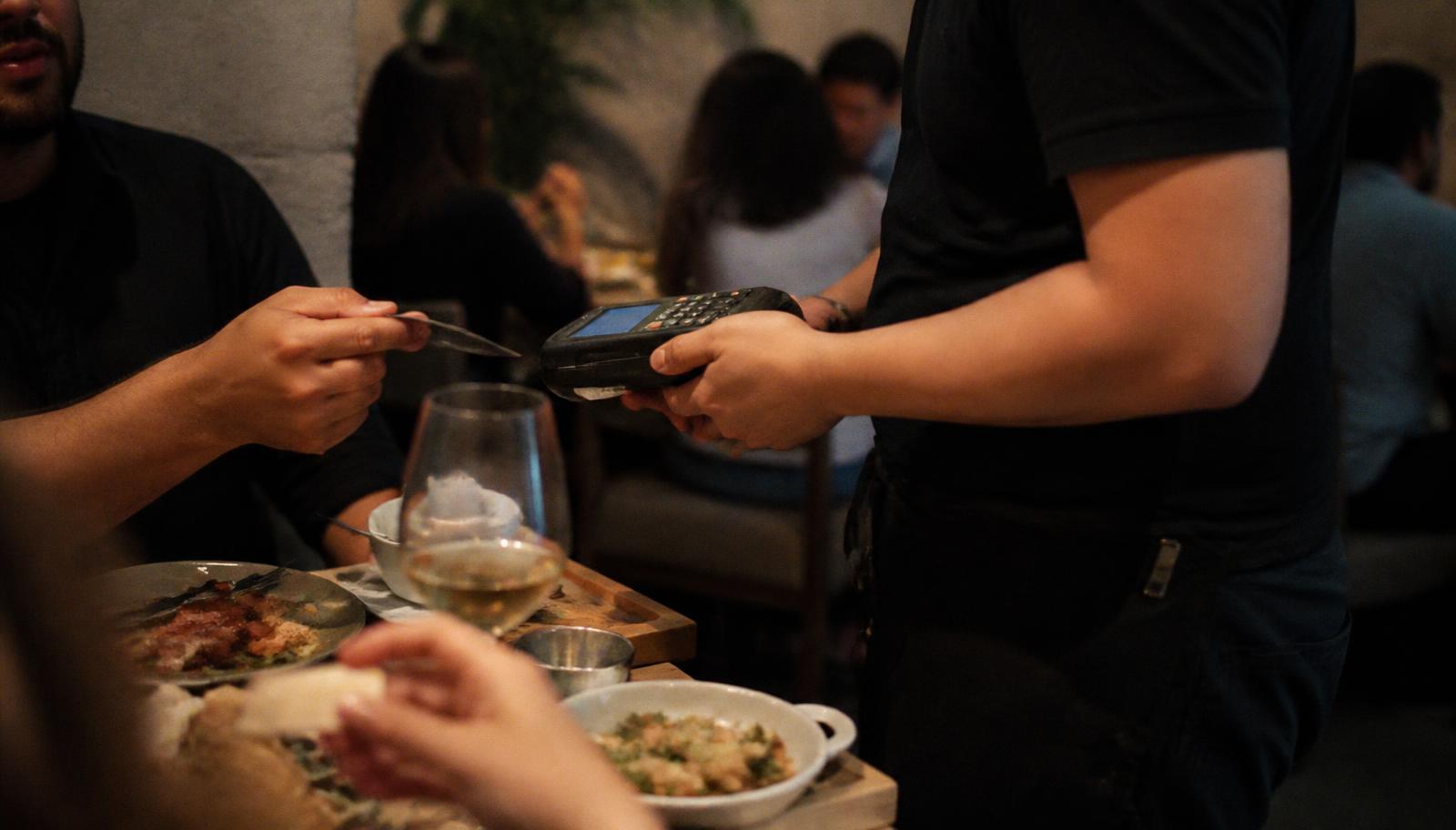
That last point is the real fix. When a guest taps at the table and picks a tip on the screen, there's no adjustment step at all. The sale authorizes once, at the correct total, in a card-present environment, the cheapest possible way to run it. Tip averages usually go up too, because a prompt with three suggested percentages outperforms a blank line on a paper slip.
Choosing the right setup for your service style
| Service style | Core setup | Why |
|---|---|---|
| Quick service / counter | Countertop POS with customer-facing tip screen | Speed at the register, tip capture before handoff |
| Fast casual with table numbers | Counter POS plus one handheld | Handles pay-at-table for larger groups |
| Full service | One handheld per section, POS stations at the pass | Fewer trips, faster turns, no walked tabs |
| Bar-heavy | Countertop with pre-auth / tab support | Holds open tabs cleanly and avoids re-runs |
| Food truck | Handheld with its own cellular connection | Works without venue Wi-Fi |
| Patio or seasonal seating | Handhelds only | No cabling to a temporary space |
Patio season deserves a special note in Minnesota, since a big share of annual revenue happens outdoors in a fifteen-week window. Running cable to a temporary patio bar is expensive and awkward; handhelds on cellular are the cleaner answer. Our guide to mobile card readers and tap to pay covers the options.
What to look for in restaurant POS software
Payments and POS are separate decisions that get sold together. The processing side determines your fees; the POS side determines whether your staff can actually work fast. Judge the POS on the things that come up at 7pm on a Friday.
- Split checks by item, by seat, and by arbitrary dollar amount, all three, not just evenly.
- Course firing and hold-and-send to the kitchen printer or display.
- Modifier depth: no onions, sub gluten-free bun, extra sauce on the side, all without a manager override.
- Open tabs with pre-authorization, and a clean way to close out an abandoned tab.
- Tip pooling and distribution reporting your bookkeeper can actually use.
- Offline mode that still lets you take orders and payments if the internet drops.
- Reporting by daypart, server, and menu item so you can cut the dishes that don't earn their spot.
For a broader comparison across business types, see our POS system guide.
Third-party delivery is a different animal
Marketplace apps charge commission in the range of 15% to 30% of the order, which dwarfs any card fee conversation. If delivery is a meaningful share of your volume, the profitable move is usually to push loyal customers toward direct online ordering on your own site, where you pay card fees plus a modest platform cost instead of a commission. Even converting a fraction of app orders to direct ordering changes your margin more than any rate negotiation could. Our guide to online payment processing covers setting that up.
Surcharging in restaurants: proceed carefully
Plenty of restaurants have added a card surcharge or a service fee line, and plenty have quietly removed it after reviews mentioned it. If you go this route, the rules matter: it can't apply to debit, it must be disclosed on the menu and at the point of sale, and it must not exceed your actual cost. Guests forgive a clearly posted, evenly applied policy far more than a surprise line on the check. Read the full picture in zero-fee credit card processing before deciding, and consider raising a few menu prices instead, a 25-cent bump on a burger is invisible in a way a 3% line item isn't.
Disputes and walked tabs
Restaurants see a specific dispute pattern: guests who don't recognize a charge weeks later, and guests who dispute a tip they say they didn't authorize. Two habits handle most of it. Make your statement descriptor the name on your sign, not your LLC. And retain signed slips or terminal records for at least 18 months so you can produce the tip authorization. More on this in how to prevent chargebacks.
A nightly and weekly routine
- 1Close all tabs, adjust all tips, and batch before the last person leaves.
- 2Reconcile the POS total against the processor deposit the following morning.
- 3Check for declined tip adjustments or unclosed tabs from the night before.
- 4Weekly, review your effective rate against the prior week and note any spike.
- 5Monthly, compare average check by daypart, it's the fastest lever on your effective rate.
Small operational habits beat rate shopping in this industry. That said, once your habits are clean, an honest rate review still finds money, see how to lower processing fees.
Working with Twin Cities restaurants
We set up payments for diners, taprooms, food trucks and full-service kitchens across Minneapolis, St. Paul and greater Minnesota. We plan around the calendar that actually drives your year: patio open, State Fair, football Sundays, holiday parties, and the February lull. That means handhelds arriving before patio season, not during it.
Send us a statement and a menu and we'll show you where your money is going per plate. Book a walkthrough or call 763-280-3155.
Frequently asked questions
Sources and references
Want this checked against your own statement?
Send us a recent processing statement and we'll mark it up line by line, what you're paying now, and what you'd pay with us. No pressure.