
Industries
Payment processing for auto repair shops
8 min read
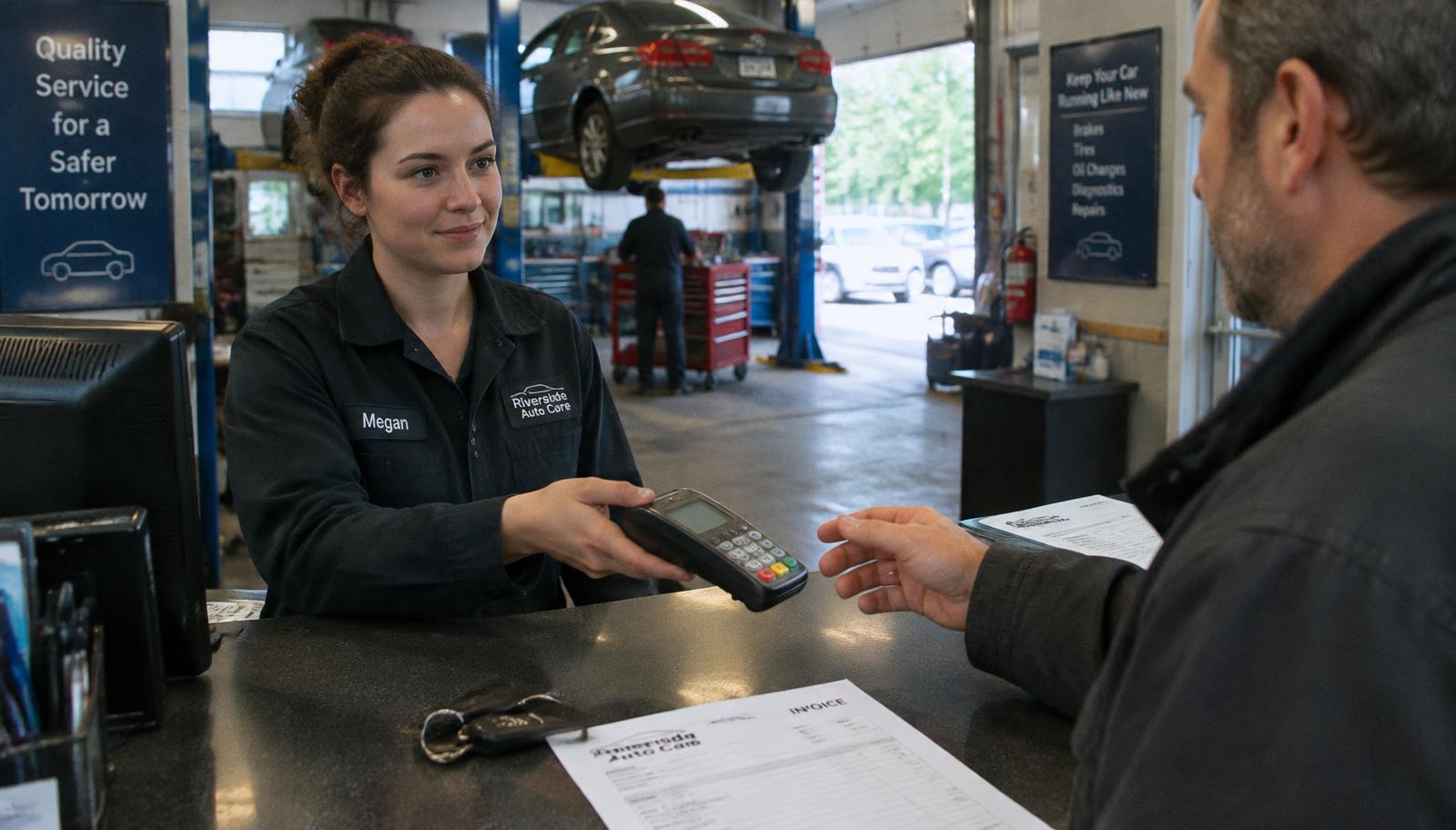
Quick answer
Auto repair shops need payment processing built for high-ticket transactions, text-to-pay so customers can pay before they even arrive to pick up, fleet card acceptance, and a pricing structure that doesn't eat into margin on big repair bills. Interchange-plus pricing and surcharging both help here more than at most other businesses.
Key takeaways
- Average repair tickets are often several hundred to a few thousand dollars, so processing rate structure matters more than at a typical small retailer.
- Text-to-pay lets customers pay their bill before arriving to pick up the vehicle, cutting time at the counter.
- Fleet cards (WEX, Fuelman, Voyager) need specific processing setup, not every terminal accepts them the same way.
- Warranty and insurance-covered repairs often involve a third-party payer, which changes how the transaction should be handled.
- Surcharging on large repair tickets can meaningfully offset fees, but must be disclosed and capped correctly.
Why auto repair payments need their own setup
A coffee shop transaction is $6. An auto repair transaction is routinely $400 to $4,000. That difference changes almost everything about how you should think about payment processing, the fee structure, the fraud risk, the payout timing, and even how the customer wants to pay. A shop running the same generic setup as a retail store is very likely leaving money on the table or making customers wait around longer than they need to.
Estimate-to-invoice: getting the money flow right
Most repair jobs start with an estimate, not a final bill. The estimate can change once a technician actually opens things up, so your payment process needs to flow cleanly from estimate to authorization to final invoice, without forcing the customer to start over or the shop to re-explain charges. A few habits make this much smoother:
- 1Send the estimate digitally and get sign-off before starting work beyond diagnostics.
- 2Take a deposit or pre-authorize a card for jobs with parts on order, this reduces no-shows on big repairs.
- 3Update the customer by text as the final invoice takes shape, especially if it changes from the estimate.
- 4Send the final invoice with a payment link before the vehicle is even ready, not after.
- 5Let the customer pay remotely so pickup is just handing over keys, not standing at the counter.
Text-to-pay: the biggest time-saver at pickup
Text-to-pay sends a secure payment link by SMS so a customer can pay their invoice from their phone, in the waiting room, at their desk, or from the rideshare on the way back to pick up their car. For a shop, this means the front counter isn't a bottleneck at 5pm when six customers all show up to grab their vehicles at once. It also means a customer can pay as soon as the invoice is final, without needing to swing by first.

Fleet cards need specific support
If you service any commercial or delivery vehicles, you'll run into fleet cards, WEX, Fuelman, Voyager, and similar, which aren't processed exactly like a standard Visa or Mastercard. These cards often require additional line-item data (odometer reading, driver ID, product type) to authorize properly, and not every processor or terminal supports that data capture. If fleet business is or could be part of your customer base, ask specifically whether your processor supports Level II/III fleet card data, a plain consumer-card setup can decline these transactions or fail to capture the detail the fleet company requires for reimbursement.
| Payment type | What's different | What to ask your processor |
|---|---|---|
| Standard debit/credit | Works like any retail transaction | Confirm interchange-plus pricing for larger tickets |
| Fleet cards (WEX, Fuelman, Voyager) | Needs extra line-item data to authorize | Does the terminal support fleet card data capture? |
| Warranty / insurance payer | A third party pays part or all of the bill | Can the system split payment between customer and payer? |
| Financing (Synchrony, etc.) | Customer applies for financing at checkout | Is it integrated, or a separate manual process? |
Warranty and insurance-covered repairs
Extended warranty companies and insurance payers (for collision work) often cover part or all of a repair bill, with the customer responsible for a deductible or the difference. This is functionally similar to how a dental office collects a patient-responsibility balance after insurance pays its share, the workflow should support splitting a single invoice between two payers cleanly, with the customer's portion collected up front or via card-on-file, and the warranty/insurance portion invoiced separately.
Surcharging on big repair tickets
Because repair tickets run high, processing fees on a $2,000 job aren't trivial, at 2.6%, that's $52 on a single transaction. Many repair shops offset this with a surcharge on card payments (commonly capped around 3% by the card networks) or a cash discount program, both of which are more impactful here than at a low-ticket business. Review our processing fees guide and confirm your state allows surcharging before adding one, a few states restrict it.
Pricing structure: interchange-plus usually wins here
| Pricing model | How it behaves on a $1,500 ticket | Best for |
|---|---|---|
| Flat-rate (e.g. 2.9% flat) | $43.50 fee regardless of card type | Simplicity, lower-volume shops |
| Interchange-plus | Often lower on debit/rewards mix, true cost plus a small markup | Higher-ticket, higher-volume shops |
| Surcharge program | Customer covers the card fee at checkout | Shops wanting to protect margin on big jobs |
Our interchange-plus vs. flat-rate guide breaks down exactly how these differ, and for most repair shops running tickets in the hundreds to thousands of dollars, interchange-plus pricing is worth the extra bit of complexity in exchange for real savings.
Funding speed matters more with big tickets
When a single transaction is $2,000+ instead of $20, the timing of when that money actually lands in your account has a real impact on cash flow, parts suppliers, payroll, and rent don't wait. Ask about next-day funding specifically, since some processors default to a 2–3 day payout that can strain a shop covering large parts invoices.

Avoiding chargebacks on big-ticket repairs
A dispute on a $2,500 transmission job hurts a lot more than one on a $6 coffee. Signed estimates, clear documentation of authorized work, and a paper trail from estimate to final invoice are your best defense, see how to prevent chargebacks for the specific habits that matter most on high-ticket work.
Minnesota businesses
We work with independent repair shops and dealership service departments across Minneapolis, St. Paul, and Minnesota to set up text-to-pay, fleet card acceptance, and pricing structures built for high-ticket repair work, not a generic retail setup that doesn't fit how a shop actually operates.
Want a payment setup built for real repair-ticket sizes? Book a free consultation or call 763-280-3155.
Frequently asked questions
Sources and references
Want this checked against your own statement?
Send us a recent processing statement and we'll mark it up line by line, what you're paying now, and what you'd pay with us. No pressure.