Payments 101
ACH payments for small business
7 min read
Quick answer
ACH payments move money directly between bank accounts through the Automated Clearing House network, instead of through a card network. For small businesses, ACH usually costs a lot less than card processing, especially on large invoices, but it settles slower and carries return risk instead of chargeback risk.
Key takeaways
- ACH fees are typically flat (often $0.25–$1.50 per transaction) rather than a percentage, so they're much cheaper on large payments.
- Standard ACH settles in 1–3 business days; same-day ACH is faster but usually costs more per transaction.
- ACH is a strong fit for invoices, B2B payments, and recurring billing where the amounts are large or predictable.
- Returns (the ACH version of a declined or reversed payment) can take days to show up, unlike a card decline which is instant.
- You need the customer's authorization and, for many uses, their bank account and routing number, plan for that step in your workflow.
What ACH actually is
ACH stands for Automated Clearing House, the electronic network banks use to move money directly between accounts in the U.S. It's the same system behind direct deposit paychecks and automatic bill pay. When a business accepts an ACH payment, money moves straight from the customer's bank account to the business's bank account, without a card network like Visa or Mastercard involved at all.
That's the core difference from card processing: no card, no card network fees, and a completely different cost and risk structure. For businesses used to thinking only in terms of card rates, it's worth reading our credit card processing fees explained guide first, just to have a clear comparison point.
ACH cost vs. credit card cost
This is where ACH gets interesting for small businesses with large invoices. Card processing fees are usually a percentage of the sale (roughly 2%–3.5%), so a $10,000 invoice paid by card can cost $200–$350 in fees. ACH fees are typically flat, often somewhere between $0.25 and $1.50 per transaction, regardless of the amount. That same $10,000 invoice paid by ACH might cost under $2.
| Payment method | Typical fee structure | Cost on a $500 invoice | Cost on a $10,000 invoice |
|---|---|---|---|
| Credit card | ~2.5%–3.5% of amount | ~$12.50 – $17.50 | ~$250 – $350 |
| ACH | Flat $0.25 – $1.50 per transaction | $0.25 – $1.50 | $0.25 – $1.50 |
| Same-day ACH | Flat fee, usually higher than standard ACH | $1 – $5 | $1 – $5 |
Standard ACH vs. same-day ACH
Standard ACH typically settles in 1 to 3 business days. Same-day ACH, now widely available, can settle the same business day if submitted before the network's cutoff times, useful for payroll, urgent vendor payments, or a customer who needs proof of payment fast. It usually comes with a higher per-transaction fee than standard ACH, but it's still generally far cheaper than card processing.
| Type | Typical settlement time | Relative cost |
|---|---|---|
| Standard ACH | 1–3 business days | Lowest |
| Same-day ACH | Same business day (if submitted before cutoff) | Moderate, still below card rates |
| Credit/debit card | Funds to merchant in 1–2 days; authorization instant | Highest (percentage-based) |
If deposit speed into your own account is the concern rather than how fast the customer's payment clears, that's a related but separate topic, see next-day funding merchant accounts for how that timing works on the card side.

When ACH makes the most sense
Invoicing and B2B payments
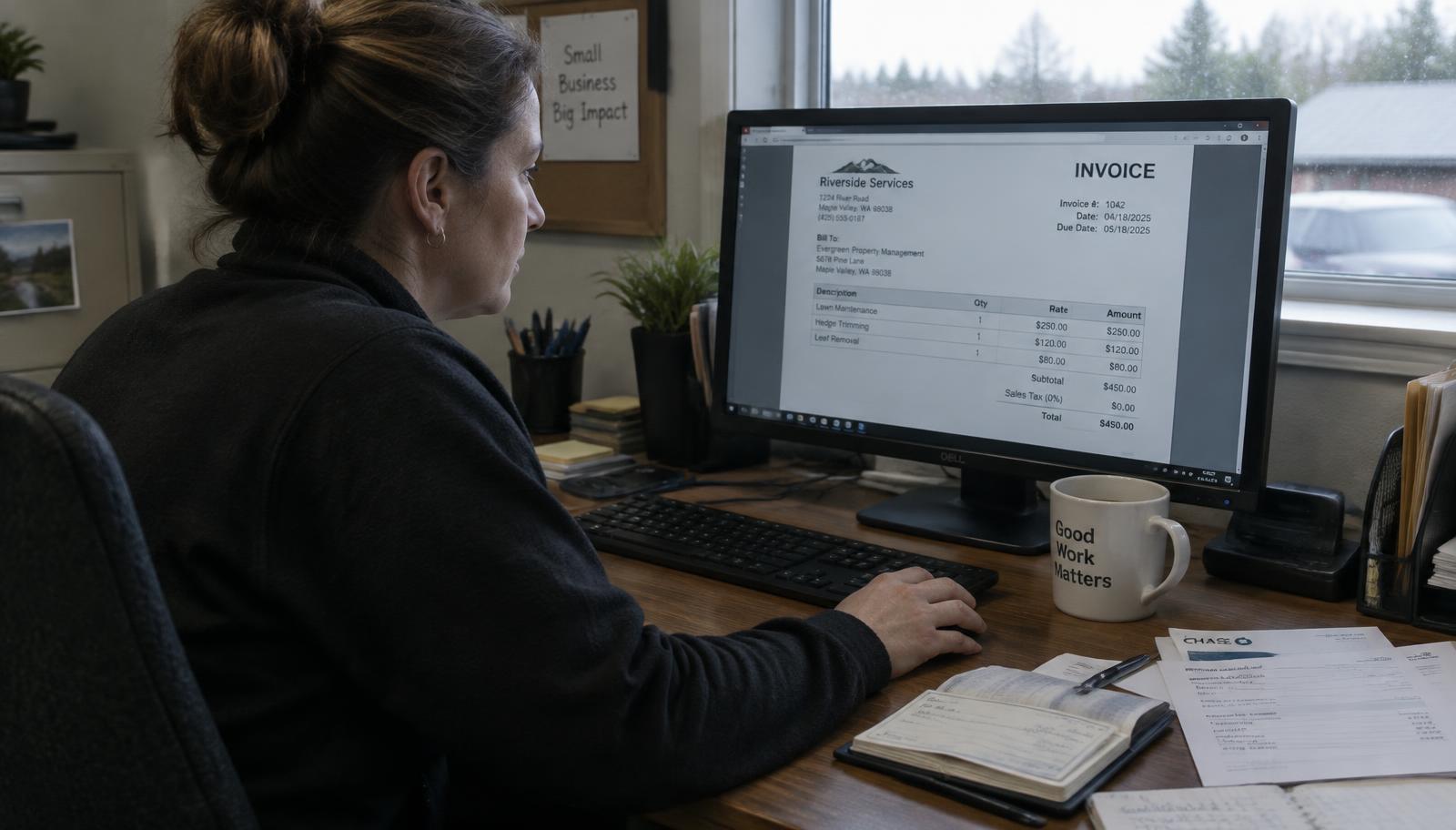
ACH is a natural fit for invoice-based businesses, contractors, wholesalers, consultants, agencies, where individual payments are large and the customer is another business rather than a walk-in shopper. B2B customers are also generally more comfortable providing bank details for a recurring vendor relationship than a one-time retail purchase.
Recurring and subscription billing
For memberships, subscriptions, or recurring service fees, ACH avoids the classic card problem of failed recurring charges from expired or reissued cards. Bank accounts change far less often than card numbers, so ACH subscriptions tend to have fewer billing interruptions over time.
- Contractors and service businesses invoicing large jobs
- Wholesale and B2B vendors with recurring purchase orders
- Membership and subscription-based businesses
- Rent, retainer, or tuition-style recurring payments
- Nonprofits collecting recurring donations
If you invoice contractor-style jobs, our guide to payment processing for contractors covers how ACH fits alongside card payments for deposits and final invoices.
When ACH is the wrong fit
ACH doesn't work well for point-of-sale retail, restaurants, or anywhere a customer expects to pay instantly and walk away, the settlement delay and the friction of entering bank details make it impractical at the counter. It's also a poor fit for a first-time, low-trust transaction where a customer would rather use a card they can dispute than hand over bank account details.
Returns and NSF risk: the ACH version of a decline
With a credit card, a declined payment happens instantly at checkout. With ACH, the payment can look successful and then bounce back days later, most commonly due to insufficient funds (NSF), a closed account, or an incorrect account number. This delayed-failure risk is the main tradeoff for ACH's lower cost.
| Return code meaning | What it means for you |
|---|---|
| Insufficient funds (NSF) | Customer's account didn't have enough money, most common return reason |
| Account closed | The bank account no longer exists, update customer info before retrying |
| Invalid account number | Usually a data entry error at signup, verify details before resubmitting |
| Payment revoked by customer | Customer contacted their bank to stop the payment, similar to a card dispute |
| Unauthorized transaction | Customer claims they never approved it, proper authorization records protect you here |
Because returns can take several business days to surface, don't treat an ACH payment as fully confirmed the moment it's submitted, especially for large one-time invoices from a new customer. Some businesses wait for full settlement before releasing goods or services on a first ACH payment from a new client.

Setting ACH up alongside your existing payments
Most processors and payment platforms can add ACH as an option next to your existing card processing, often through the same invoicing tool or gateway. The bigger question isn't which one, it's when to offer which: cards for speed and small transactions, ACH for large invoices, recurring billing, and B2B relationships where the delay is a non-issue.
- 1Offer both card and ACH on invoices over a certain size (many businesses set this around $500–$1,000).
- 2Use ACH by default for recurring billing to cut down on failed-card interruptions.
- 3Keep cards as the default for in-person and small one-time transactions.
- 4Collect proper authorization records regardless of which method is used.
- 5Review your effective cost per payment method quarterly, the mix matters as much as the rate.
Minnesota businesses
We set up ACH alongside card processing for contractors, wholesalers, and subscription-based businesses across Minneapolis, St. Paul and greater Minnesota, usually as a way to cut fees on their biggest invoices without disrupting how customers who prefer cards already pay.
Curious how much ACH could save on your invoice volume? Book a free consultation or call 763-280-3155 and we'll run the numbers with your actual figures.
Frequently asked questions
Sources and references
Want this checked against your own statement?
Send us a recent processing statement and we'll mark it up line by line, what you're paying now, and what you'd pay with us. No pressure.